Fat tails
Peking University Financial Review
Cover Story | 封面

Costly tipping points
New research shows significant economic costs of climate risks.
NBER Summer Institute
Environmental & Energy Economics
Nightmare Climate Scenarios
The economist Martin Weitzman got scientists and politicians to think about the worst-case outcomes of global warming. We’re seeing them happen right now.
Economics Needs a Climate Revolution
With its fixation on equilibrium thinking and an exclusive focus on market factors that can be precisely measured, the neoclassical orthodoxy in economics is fundamentally unequipped to deal with today's biggest problems. Change within the discipline is underway, but it cannot come fast enough.
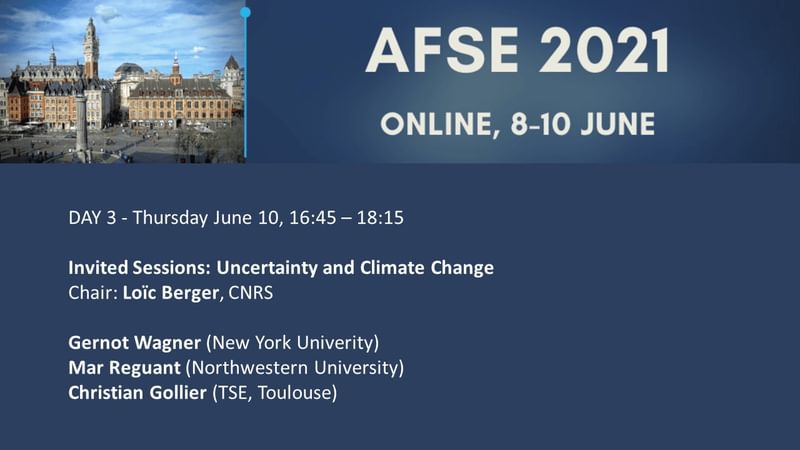
AFSE 2021
French Economic Association Annual Meeting
Harvard Environmental Insights podcast
Conversation with Rob Stavins
Virtual Seminar on Climate Economics
Federal Reserve Bank of San Francisco
Volatility and Risk Institute
NYU Stern

University of Gothenburg
Göteborg, Sweden

Montclair State University
Montclair, NJ
Festival of Economics
Trento, Italy

Climate Alarm is Not Alarmism
New information about the link between atmospheric CO₂ and eventual global average warming bolsters the case for climate policy now
Climate Economics Nobel May Do More Harm Than Good
By Marlowe Hood/Agence France-Presse

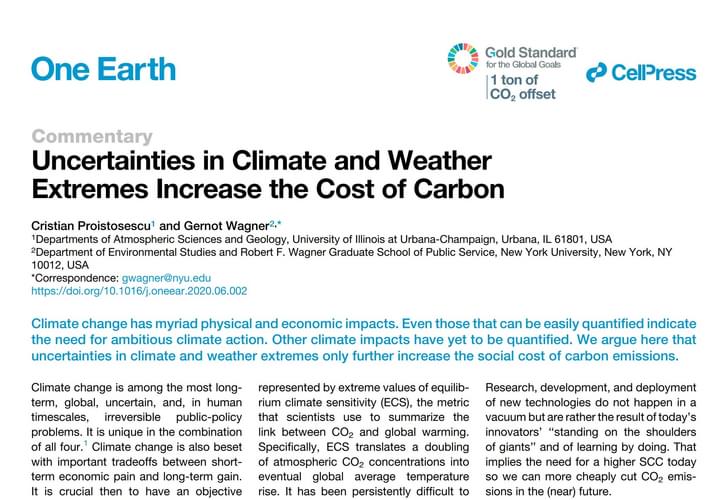
Uncertainties in Climate and Weather Extremes Increase the Cost of Carbon
Uncertainty is not our friend
In a Summer of Extreme Weather, Climate Costs Remain Mysterious
The economics of climate attribution are lagging behind the impacts of dangerous weather.
The Leadership Failure That Will Cost Us Everything
If COVID-19 has taught us anything, it is that delaying prudent policymaking does not merely result in higher marginal costs down the road. Rather, it puts us on an entirely different trajectory – one that all too easily can end in catastrophe.
BECC
Webinar

University of Maryland
College Park, MD