Reenergizing Nuclear Power
Columbia Business School Climate Knowledge Initiative
Nuclear energy use has decreased from its peak of 17% in the 1990s to 9% today, and deployment has largely moved from Europe and the United States to India and China. Yet, with accelerating power demand from (industrial) electrification and data centers, and record-high public support, this safe, clean, and dispatchable energy source is primed for a revival.
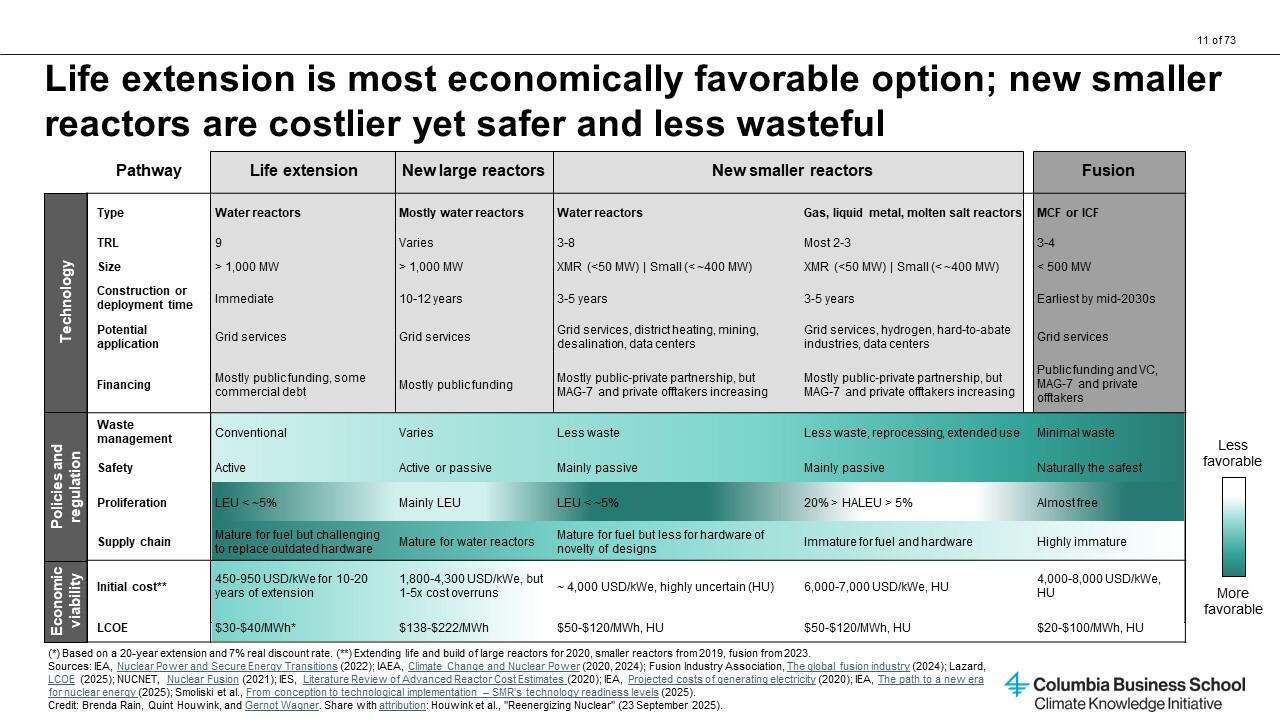
There are four pathways for the future of nuclear power:
- Extending the lifetime of existing nuclear plants, which has the lowest LCOE.
- Building new large reactors, which has low technology risk but high cost overruns and long time horizons.
- Developing small modular reactors (SMRs), which provide more flexibility, but are still emerging technologies.
- Developing fusion technology, which addresses many of nuclear’s challenges, but has yet to prove it can produce commercial power.
See Reenergizing Nuclear to explore the role of nuclear power in the future of energy.


